

By: Colleen Weber
Retirement Planning
Comments: No Comments.
By Colleen Weber, CFP®, CPA
Looking to boost your retirement savings and keep more of your hard-earned money?
A Roth IRA conversion might be just what you need. By transferring funds from a traditional IRA to a Roth IRA, you could watch your savings grow tax-free and make tax-free withdrawals in retirement.
But how do you know if a Roth conversion fits into your financial strategy? At Colleen Weber CPA, CFP®, we provide the insights you need to make confident decisions tailored to your unique situation.
Let’s review the key differences between traditional and Roth IRAs, break down the conversion process, and determine if it’s the right move for you.
Traditional vs. Roth IRA
A traditional IRA provides a tax benefit on the front end, meaning qualifying individuals enjoy a benefit sooner rather than later. Contributions are made with pre-tax money. Come tax time, the contributions made over the last year are fully or partially tax-deductible based on income and whether you or your spouse is covered by a work-sponsored retirement plan.
Here’s a breakdown based on tax filing status:
- Single: The tax deduction phases out for those who are covered by a workplace retirement plan and have an adjusted gross income ranging from $79,000 to $89,000.
- Single: The tax deduction is available for any amount of AGI if the taxpayer is single and not covered by a workplace retirement plan.
- Married: The tax deduction phases from $126,000 to $146,000 for the spouse making traditional IRA contributions with a work retirement plan.
The 2025 max annual contributions into a traditional IRA is $7,000 (or $8,000 for those over 50). A traditional IRA also comes with a required minimum distribution (RMD), beginning April 1 after your 73rd birthday. (Note: Under the SECURE 2.0 Act, that RMD age will rise to 75 in 2033.) Ignoring the RMD will land you a hefty penalty fee.
On the contrary, a Roth IRA provides a tax benefit once you’re ready to withdraw the funds. The money you fund your Roth account with is taxed prior to depositing. When it’s time to cash in, you will not be assessed any further taxes on the initial investment or the gains.
Unlike a traditional IRA, there is no RMD associated with a Roth IRA. You may also withdraw contributions at any time. But be careful to not withdraw any of the gains before you’re 59½ years of age to avoid a 10% penalty fee.
Roth IRA Conversion and Taxes
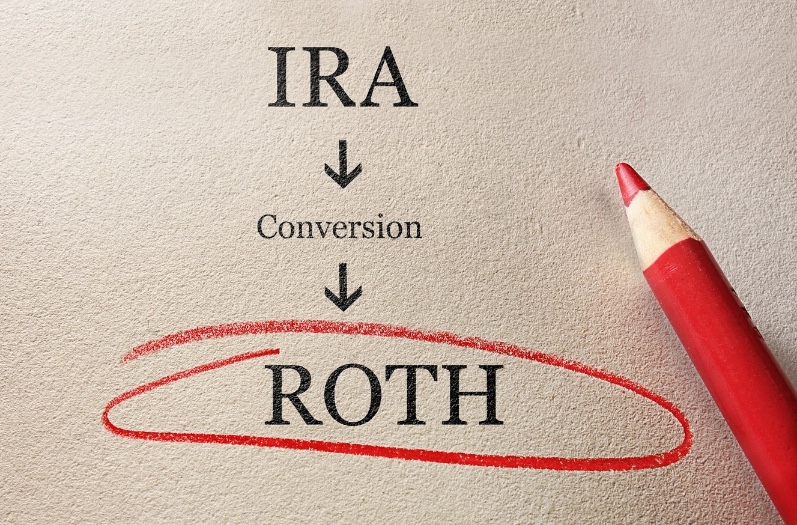
A Roth IRA conversion is when you move funds from a traditional IRA into a Roth IRA. In the case of a Roth IRA conversion, you’re ultimately deciding the tax benefits of the Roth are superior to a traditional IRA, based on your financial scenario.
But how is that determined? Consider the tax bracket you are in today. Now take a moment to consider which tax bracket you may be in when it’s time to retire. Would you rather pay taxes at today’s rate? Or the anticipated rate of the future? Answering these questions is the simplest way to determine if a Roth IRA or traditional IRA better suits you.
What About Income Eligibility Caps?
There are income caps associated with who is or is not able to contribute to an IRA. Here’s a summary of Roth IRA eligibility based on your modified gross income:
Single Tax Filing Status:
- $150,000 or less: You can contribute the maximum limit.
- $151,501–$165,000 range: You can contribute a reduced amount.
- Over $165,000: Not eligible
Married Tax Filing Status:
- $236,000 or less: You can contribute the maximum limit.
- $226,001–$246,000 range: You can contribute a reduced amount.
- Over $246,000: Not eligible
What if you see yourself in a higher tax bracket in the future but you’re not eligible to contribute to a Roth IRA? Is there a way to still take advantage of the Roth account tax benefit? At first glance, it may seem as if you’re out of luck. But in reality, there are no income limits associated with a Roth IRA conversion.
Is a Roth IRA Conversion Right for You?
If you’re concerned about being in a higher tax bracket when it’s time to withdraw from your traditional IRA, a Roth conversion could be the solution.
It’s completely normal to feel uncertain about which retirement account is right for you, especially when taxes are involved! The complexities can be overwhelming, but you don’t have to navigate them on your own.
At Colleen Weber CPA, CFP®, we help you evaluate whether a Roth conversion makes sense for your situation and walk you through every step. Let’s get started on the path to a more stable retirement— book a free introductory meeting online or call (952) 470-0750 today!
About Colleen
Colleen Weber is a fee-only financial advisor, CERTIFIED FINANCIAL PLANNER® professional, and CPA based in Chanhassen, Minnesota. With more than 20 years of financial planning experience, Colleen provides comprehensive financial planning and wealth management. She specializes in serving clients nearing retirement, retirees, busy professionals, and women. She is passionate about developing financial plans that save clients on taxes and investment strategies that help them pursue their goals. Learn more about Colleen by connecting with her on LinkedIn or booking a complimentary phone call meeting.